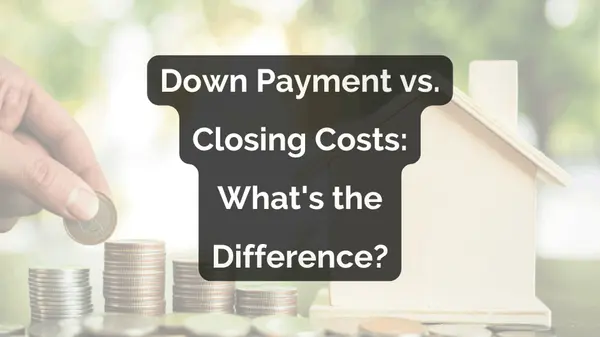

Closing Costs vs. Down Payment: What's the Difference?
Hello there! If you’ve started looking at houses, you’ve probably heard the term "Cash to Close" or been warned about those mysterious "Closing Costs."
As a seasoned real estate agent, I see it all the time: a buyer saves up a big chunk of money for their down payment, feeling like a financial superstar, only to realize there’s a second "bill" waiting for them at the finish line.
If you’re wondering, "Wait, I already saved my down payment... what else is there?"—don't panic! You are not alone. Let's pull back the curtain and clear up the confusion between Closing Costs vs. Down Payments.
🏠 The Down Payment: Your "Slice" of the House
Think of the down payment as your Equity Starter Kit. This is the portion of the home’s purchase price that you pay upfront, and it determines how much money you actually need to borrow from the bank.
The Highlights:
-
Where it goes: Directly toward the price of the house. If you buy a $300,000 home and put $10,500 (3.5%) down, you now owe the bank $289,500.
-
The "20% Myth": In 2026, you definitely don't need 20% down. While that’s great for avoiding Private Mortgage Insurance (PMI), many buyers use FHA loans (3.5% down) or conventional loans (as low as 3%) to get into a home sooner.
📑 Closing Costs: The "Cost of Doing Business"
If the down payment is your investment in the house, closing costs are the fees you pay to the people who made the transaction happen. This includes the lender, the title company, the local government, and even the appraiser.
In today's market, you can typically expect closing costs to range from 2% to 5% of the purchase price.
What’s inside that "Closing Cost" bag?
-
Loan Origination Fees: What the bank charges to set up your mortgage.
-
The Appraisal: Paying a professional to confirm the house is actually worth what you’re paying.
-
Title Insurance: Ensuring no one else can legally claim they own your new backyard.
-
Government Recording Fees: The cost to tell the county, "Hey, this house is mine now!"
-
Prepaids: This is the one people forget! Lenders often want you to pay a few months of homeowners insurance and property taxes upfront into an "escrow account."
🤔 Are They the Same Thing? (The Big Question)
The short answer: No. They are two separate piles of money. One builds your ownership (Down Payment), and the other covers the administrative and legal work of the sale (Closing Costs).
When you get to the "Closing Table" (where you sign your life away and get the keys!), you will need to bring BOTH. Your lender will give you a document called the Closing Disclosure that adds these two numbers together into one final total called "Cash to Close."
💰 A 2026 Example:
Let's say you're buying a $250,000 home in Marshfield, MO:
-
Down Payment (3.5% FHA): $8,750
-
Closing Costs (Est. 3%): $7,500
-
Total Cash to Close: $16,250
🤝 Pro Tip: How to Lower Your Out-of-Pocket Costs
If that "Cash to Close" number looks a little scary, don't worry. As an agent, I have a "secret weapon" called Seller Concessions.
In the 2026 market, we can often negotiate for the seller to pay some (or all!) of your closing costs. This means you only have to worry about your down payment, saving you thousands of dollars at the move-in stage.
✨ “Helping you find the home that sparks joy.”
Christina Sparks > Realtor | Real Broker > Owner, House of Sparks > 📍 Serving Springfield, MO & Surrounding Areas
📞 417-350-6419 🌐 thehouseofsparks.com
Categories
Recent Posts